Several years ago, I read a book called ‘Bird by Bird’ by Anne Lamott. There was a part that she described as an “Emotional Acre” and since then I have had this concept stuck in my head. Here is the quote from that book:
“Every single one of us at birth is given an emotional acre all our own. As long as you don’t hurt anyone, you really get to do with your acre as you please. You can plant fruit trees or flowers or alphabetized rows of vegetables, or nothing at all. If you want your acre to look like a giant garage sale, or an auto-wrecking yard that’s what you get to do with it. There’s a fence around your acre, though, with a gate, and if people keep coming onto your land and sliming it or trying to get you to do what they think is right, you get to ask them to leave. And they have to go, because this is your acre.”
I thought this was such a beautiful way to depict healthy boundaries and emotional responsibility and this imagery lit a spark in my imagination. I started a rough painting of several small figures on a large canvas. The figures were sitting in separate little yards by themselves. Some were reaching over into other’s yards. Some yards were barren; some were full of flowers.
The ideas were turning.
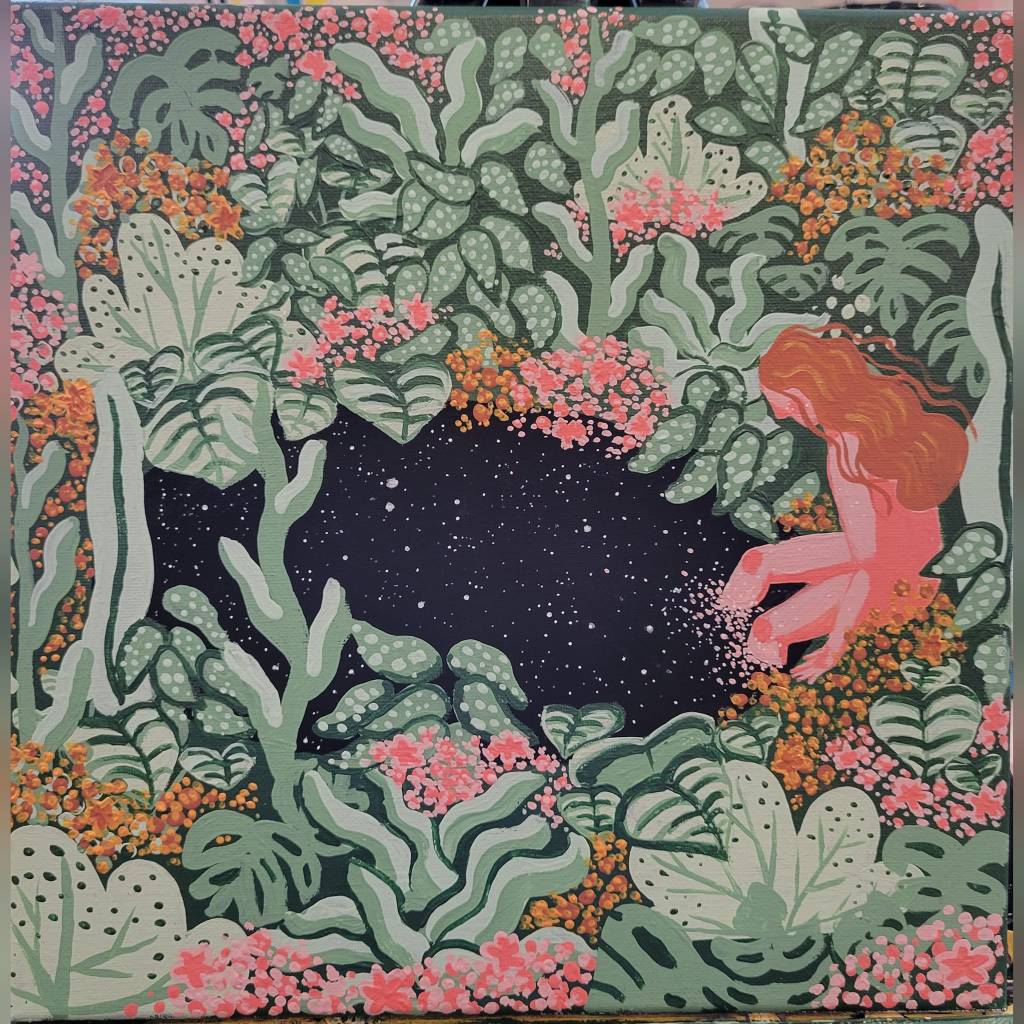
I painted another picture. This one was of a girl in a beautiful, overgrown garden, and she was getting into a pool full of stars. As she descended into the water, her body began to dissolve into the stars. I called this painting ‘The Return.’
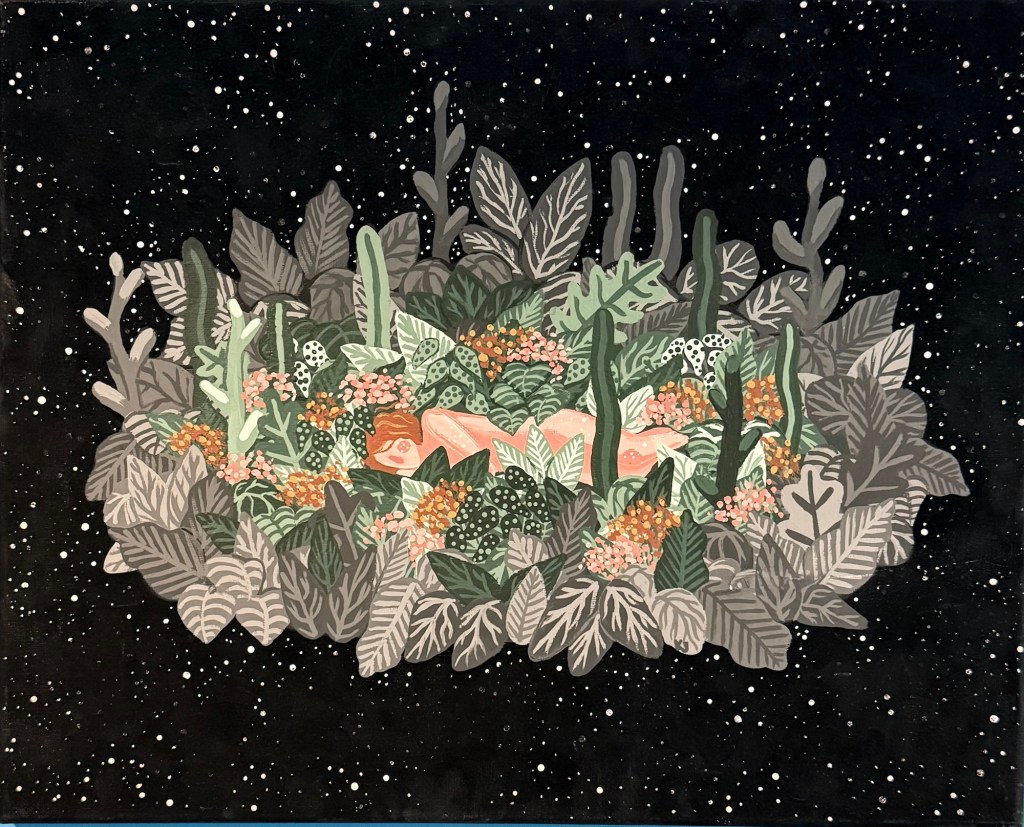
About 5 years ago, I was dealing with a season of depression and I painted another emotional acre of a woman laying in the middle of an island. The flowers in her garden surrounding her were blooming and green, but the ones on the outside were gray.
A few years ago, I was recommended a book called ‘Women Who Run With the Wolves,’ by Clarissa Pinkola Estés, Ph.D. She is a scholar, award-winning poet, Diplomate Senior Jungian psychoanalyst, and cantadora–keeper of the old stories in the Latina tradition. In this book she takes folk lore and fairy tales, dissects them, and analyzes their symbolism. I cannot recommend this book enough!
Here is part of the beginning of that book that stuck with me:
“LA LOBA
There is an old woman living in hidden places that everyone knows in their souls but few venture in search of. She knows this, and often seems to wait for the lost or wandering people and seekers to come to her.
She is to be found in the most unsuspecting places, often away from the crowd. She calls herself by many names: La Huesera (Bone Woman); La Trapera (The Gatherer); and La Loba (Wolf Woman).
The sole work of La Loba is to collect bones. She is there to preserve what is in danger of being lost. La Loba is a collector of bones, so that she is able to recreate – once she has assembled an entire skeleton she sits by the fire and thinks about what song to sing. When she is certain she stands over the criatura, raises her arms and sings out. This is when the rib bones and leg bones of the wolf flesh out and the creature becomes furred. La Loba sings to bring it back to life, to bring air back to its lungs, till the wolf leaps and runs down the canyon.
Somewhere in its running, whether by speed or splashing into water, or by the rays of the sun or moonlight hitting its side, the wolf transforms into a woman. A woman laughing as she runs free to the horizon.
So if you’re wandering the desert, and it’s near sundown and you’re slightly weary and surely lost and tired, you might be lucky enough that La Loba takes a liking to you and shows you something of the soul.”
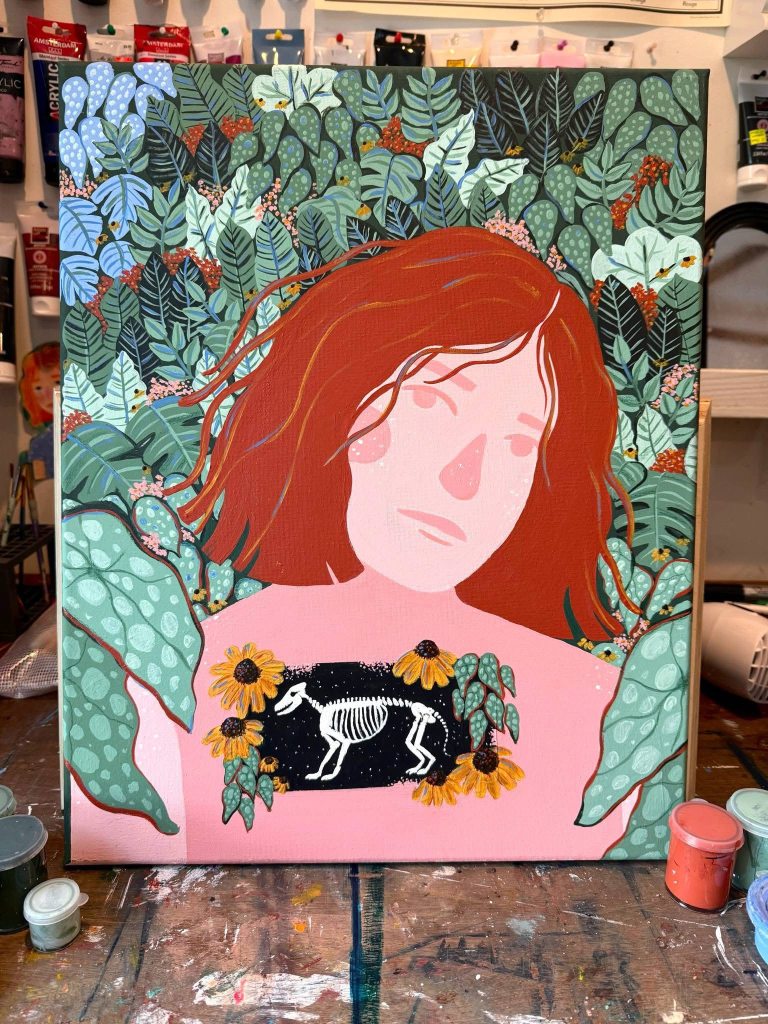
The painting I did that was inspired by the story of La Loba sat unfinished in my closet for two years, and I finished it about a year ago. I called it ‘The Soul Song.’
I have spent a lot of time (emotionally) wandering in the desert and wilderness. Trying to understand, and wondering ‘why’ and ‘what if’.
But, these questions keep us stuck- grumbling and complaining- wandering in the wilderness for years (maybe even forty, like the Israelites!)
There are seasons for everything. There are seasons when some areas will bloom, and others won’t. There are seasons where it seems like nothing is blooming at all and I am left wandering and gathering seeds from dead plants, like La Loba collecting bones.
Some seasons are spent planting seeds, and tending to their growth- singing things back to life that I thought were lost. Growing things that bring me light, and nurturing things that remind me of my connection to my creator, the lover of souls. Allowing myself to be sung back to life.
I used to see my emotional acre as something fragile. Something that needed constant protection, so I spent most of my time guarding my fence and wondering why my acre wasn’t thriving.
I have learned over the years, though, that my acre didn’t need defending, it needed tending, and I was the only one who could do it.
Instead of a quote, today I will leave you with a few questions:
What does your acre look like?
What do you want it to look like?
What do you need to do to change it?

 Woven In Wonder
Leave a comment